There’s nothing wrong with push-ups, squats, planks, and jumping jacks. They work. They’ve always worked. But after months of the same indoor circuit, they’ve also gotten spectacularly dull, to the point where reorganizing your sock drawer feels like a legitimate upgrade.
Spring is the reset your training has been waiting for. The weather has turned, the daylight is back, and everything outside your front door (the yard, the street, the nearest patch of grass) is a gym you’ve been kept from for months. If you’ve also got a list of yard projects stacking up, even better. You can knock out two things at once.
These seven outdoor workout ideas won’t show up in the usual “go outside and do burpees” listicles. They’re for people who want to move smarter, not just harder, and who want their workout intel to have some science behind it.
1. Ruck your way to functional strength.
Somewhere in your house is a backpack you’re not using. Fill it with water bottles, books, or canned goods, lace up your shoes, and walk. That’s rucking. It sounds simple, but it’s one of the most effective loaded training methods you’ll find without spending a dollar.
If you’ve seen the weighted vest trend dominating fitness TikTok, the concept is identical. Research on loaded walking confirms that load mass is the primary driver of both metabolic and cardiovascular demand. More weight means more work, regardless of where it sits on the vest. A 2025 peer-reviewed study found that heart rate rises proportionally with load, while metabolic cost accelerates even faster at heavier weights. A backpack lets you adjust load on the fly and carry water for longer sessions, which a fixed vest can’t match.
Start with 10–15% of your bodyweight in the pack and walk at a deliberate pace for 20–45 minutes. When you’re ready to progress, increase either your weight or your distance (not both at once) and keep increases to around 10% at a time.
2. Turn spring cleanup into a training session.
Remember the first day of football tryouts, when the farm kids came in? We all know at least one who came in looking like he just rolled off a hay bale but quickly showed himself a man amongst boys. My summer hitting the weights was no comparison to his throwing bales and driving fence posts. Outdoor physical work builds strength and mobility in muscle groups that are genuinely difficult to train in a gym because it loads the body in ways that machines and barbells simply don’t replicate.
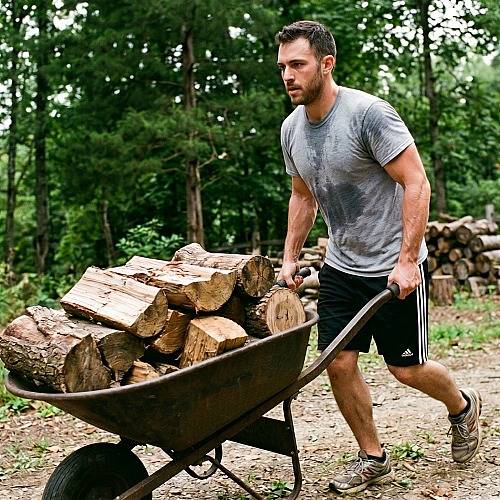
The farm kid’s gym was whatever was in front of him that morning. He didn’t program it, he didn’t track it, and he definitely didn’t post it. He just worked. Hauling bags of mulch, shoveling out garden beds, and pushing a loaded wheelbarrow have always been resistance exercises. You’ve just been calling them chores.
The difference between a chore and a training stimulus is intention. Carry bags of soil in each hand like a farmer’s carry, shoulders packed, core engaged, short, deliberate steps. Push the wheelbarrow with intention, posture up, core braced, and drive from the legs. Shovel with a proper hip hinge rather than rounding your back through every rep and wondering why it hurts the next morning.
The yard gets cleaned up either way. You might as well come out of it with a real workout and a guilt-free second helping.
A Few Yard-Work Moves Worth Doing Right
Bag carries (bilateral or unilateral): 30–50 feet at a time, two to three rounds per hand
Wheelbarrow push: Full length of the yard and back, posture up, no hunching
Rock or paver relocation: Treat each lift as a deadlift, hinge at the hips, protect the lower back
3. Hang from things on purpose.
This one gets overlooked because it looks like you’re doing nothing. Find something overhead and hang from it passively for 30–60 seconds at a time. Good candidates include a sturdy tree branch, a porch beam, a doorframe pull-up bar, or a horizontal bar at the park.
You are, in fact, doing something. Dead hangs take tension off the shoulders and spine, open up the shoulder joint, and develop grip strength, all in one held position. They’ve become a staple in biohacking and longevity circles because the return on investment per second of effort is genuinely hard to beat.
Progress over time by adding active hangs (engage the shoulder blades slightly) and eventually scapular pulls. Three to five sets of 30–60 seconds, done consistently, make a meaningful difference in shoulder health and grip strength. Just make sure whatever you’re hanging from is genuinely load-bearing. Test it first. Nature is not OSHA compliant.
4. Push and pull against things that don’t move.
Isometric training, applying maximum force against a fixed object, is one of the most efficient strength tools available, and most people walk right past its opportunities every day.
Tree or fence push: Face a solid trunk or post, place both palms flat, and press hard for 7 to 10 seconds. This targets the chest and shoulders.
Post row: Face a vertical post or fence rail, grip it with both hands, lean back slightly, and pull toward it as hard as possible for 7 to 10 seconds.
Car push: Parking brake on, both hands on the rear of a parked car. Drive through your legs and core for 10–15 seconds. This one is humbling in the best way.
Isometrics build real strength at the specific joint angles you train, load the muscle without movement, and are easy on connective tissue, making them one of the smartest options for anyone working around a nagging injury or managing joint soreness.
5. Make the ground itself the equipment.
Flat, even flooring is a luxury your body doesn’t need and never evolved for. Spring grass, sloped lawns, mulch beds, and soft soil all create unstable surfaces that challenge stabilizing muscles your indoor workout hasn’t spoken to in months.
Single-leg work (Romanian deadlifts, slow reverse lunges, single-leg balance holds) done on soft or uneven ground demands far more from the ankles, knees, and hips than the same movement on tile or concrete. For anyone focused on proprioception and long-term joint resilience, this kind of free variability is worth seeking out.
Move your single-leg exercises from the flat driveway to a gentle lawn slope. The difference is immediate and a little humbling at first, which means it’s working.
Bonus: Go barefoot. The sensory receptors in your feet contribute to balance and nervous system feedback in ways your shoes have been suppressing. It’s free, it feels good, and your biohacker friends will absolutely approve.
6. Crawl like you mean it.
Bear crawls and crab walks have been floating around fitness content for years, but they rarely make the outdoor workout lists. That’s a strange omission because they’re genuinely hard.
Moving on all fours across grass challenges the shoulders, core, and hips in ways isolated exercises simply can’t replicate. Yes, you will look a little ridiculous in the yard. Do it anyway. Quadrupedal movement is linked to motor control and neurological function, and the grass gives you a forgiving surface that keeps the session joint-friendly.
Bear crawl: Hands and feet on the ground, knees hovering two to three inches off the grass. Move forward 15–20 feet, then reverse.
Crab walk: From a seated position, put your hands and feet on the ground, then lift the hips. Move laterally or forward for 15–20 feet.
Lateral leopard crawl: Similar to the bear crawl but moving sideways, which increases rotational demand on the core.
Crawl the length of the yard a few times, and you’ll understand why these deserve more respect than they get.
7. Walk in Zone 2 with two rules.
Zone 2 cardio is sustained aerobic work, and it’s one of the most researched, most consistently endorsed methods for building metabolic health, improving fat oxidation, and developing cardiovascular efficiency. It also looks, from the outside, like a casual stroll. Don’t let that fool you.
Rule one is the ceiling. Nasal breathing only. If you have to open your mouth to keep up with your own pace, you’ve pushed out of Zone 2. Rule two is the floor. You should be able to speak a short sentence, but it should take a little effort. If you can hold a full, comfortable conversation without thinking about it, you’re coasting in Zone 1 and not getting the stimulus you came for. Research consistently validates the talk test as a reliable marker of the first ventilatory threshold, which defines the Zone 2 boundary.
Twenty to 45 minutes of Zone 2 walking, three or four times per week, pays real dividends in aerobic base, stress recovery, and sleep quality. Do it in the morning sunlight while you’re at it. Morning light exposure anchors your cortisol curve, sharpens alertness, and sets the tone for better sleep that night. Few workouts deliver this much return for this little drama.
Get outside and get after it.
The best outdoor workout is the one you’ll consistently do, and spring removes most of the excuses that kept you inside all winter. The cold, the dark, and the urge to stay on the couch are no longer valid. Seven ideas are on the table. Pick one and go. There’s never been a better time to step outside and find out what your body is capable of.
Building the habit is step one. Creating a training approach that evolves with you is equally important. Our guide to strength training after 40 will help turn your new habits into a viable system that continues producing results, even as those pesky hormones turn against you.
The information in this article is intended for general educational purposes only and does not constitute medical advice. Always consult a qualified healthcare provider before beginning any new exercise program, particularly if you have a pre-existing medical condition, injury, or health concern. Listen to your body, progress gradually, and stop any activity that causes pain or discomfort.





Leave a Comment
Your email address will not be published. Required fields are marked *