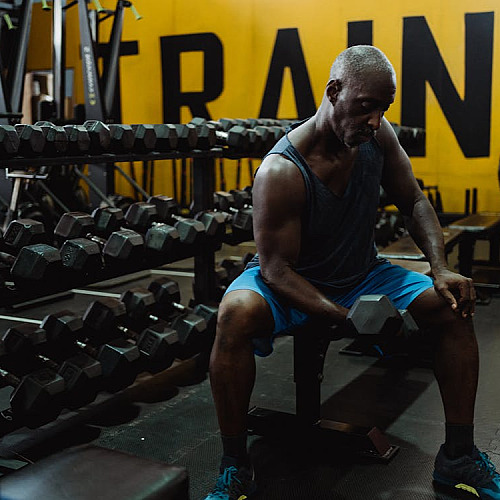
I’ve been hitting the gym consistently for two decades, but something shifted around age 43. The six-pack that used to appear with minimal effort? Now it takes twice the work. My recovery time has stretched from a day to three. And then there’s my wife, who has started patting my belly with a little too much enthusiasm.
If you’re over 40 and noticing similar changes, you’re not imagining things. Your body is changing. It sucks, but you can adapt. Let’s look at a few reasons you might be losing that youthful tone and some easy fixes to stay looking your best.
The Testosterone Reality
Research published in Reproductive Biology and Endocrinology shows that testosterone levels begin declining around age 35, with studies in men aged 40–70 showing decline rates of about 0.4% annually for total testosterone and 1.3% annually for free testosterone. By your mid-40s, the cumulative loss from peak levels can reach 15–20%, directly impacting muscle protein synthesis and fat distribution.
A study in the Journal of Clinical Endocrinology & Metabolism found testosterone levels have been declining across the male population, independent of age. A 45-year-old today has lower testosterone than a 45-year-old measured 20 years ago.
Lower testosterone doesn’t mean you can’t build muscle, just that you need to be more strategic. Resistance training remains highly effective at increasing muscle mass in men over 40, but taking precautions to prevent injury is essential so you can stay consistent with your lifts.
Muscle Recovery Takes Center Stage
When I was 25, I could train heavy six days a week and feel great. At 43, that same schedule leaves me perpetually sore and stagnant. Call it maturity. (My ego calls it wimpiness… but I press on).
After 40, your body produces less human growth hormone during sleep when you’re supposed to be repairing, and inflammatory markers stay elevated longer post-workout. A 2024 narrative review found that aged muscle displays delayed recovery, which may mean more time is needed between training sessions.
The fix is straightforward. I shifted from six training days to four and saw better strength gains in three months than the previous year. I also separated muscle groups more deliberately to give myself breaks. For instance, instead of back and biceps day, I now train only one muscle group at a time, which gives me more time to recover before the next bicep day.
Recovery has become just as important as the workout itself. Turmeric tea is now a daily treat for me, and Epsom salt baths after heavy training days are just part of the routine.
Metabolic Changes and Body Composition
That stubborn midsection fat stems partially from muscle loss. Research in Current Opinion in Clinical Nutrition and Metabolic Care shows muscle mass decreases 3–8% per decade after age 30, and since muscle tissue burns calories at rest, you’re losing the tissue that naturally keeps you lean.
To combat this, I made major adjustments to my nutrition, which I feel has helped more than anything else. I moved my creatine to after my workout, as a 2021 review suggests it may help more with muscle recovery when taken after. I also do 5–10 minutes of moderate exercise after every meal to curb blood sugar spikes, a strategy supported by a 2024 review. This can be anything from a quick walk around the block to a ride on the stationary bike, or even jumping jacks and push-ups. With concerns like high cholesterol and a family history of colon cancer, I’ve also increased my fiber intake and gotten religious about lean protein. Bring on the tuna packs.
The Timeline Shift
At 25, I could cut weight in days and see abs in a couple weeks at most. At 43, the same deficit takes twice as long to produce half the results. This is the metabolic reality of declining testosterone, reduced growth hormone, and a metabolism more efficient at storing fat.
Muscle definition follows the same timeline. Cuts that used to appear after a month now take eight to twelve weeks. The psychological adjustment is the hardest part. Comparing your current timeline to past results breeds frustration. It’s best to just accept that the process now requires more strategic planning and realistic expectations.
Taking Joint Health Seriously
I haven’t dealt with major injuries, but occasional knee bursitis after hard training sessions reminds me that decades of lifting and sports create cumulative stress.
To combat injury, I certainly pay more attention to my form now, but I also spend 15 minutes on mobility work before every session. This focuses on flexibility and stability, using band pull-aparts, hip circles, and dynamic stretches. These exercises feel tedious, but I’ve realized they’re preventing injuries that could sideline me for months. My wife, who works out with me, has also noticed improved balance from these stabilizer exercises.
As you age, consider dropping your working weights to avoid injury. My father dropped his by about 10% and focused on perfect form and controlled tempo. His joints thanked him, and his muscle development didn’t suffer. That tracks with the 2021 study that found that moderate loads produce similar hypertrophy to heavier loads when sets are challenging.
What Doesn’t Change
Your ability to build strength and muscle doesn’t disappear at 40. Progressive overload still applies. You can still add weight to the bar, increase reps, and transform your body.
Plus, your discipline, accumulated knowledge, and training experience give you advantages over younger lifters. You understand form better, know how to listen to your body, and can be patient with progress.
A meta-analysis in Ageing Research Reviews confirms that men in their 50s and beyond can achieve significant strength and muscle gains with proper programming, so don’t get down on yourself.
Moving Forward
The game changes after 40, but you’re not out of it. You need smarter programming, better recovery, more attention to nutrition timing, warm-ups that matter, and sleep that’s non-negotiable.
What you don’t need is to accept decline as inevitable. Your body still responds to resistance training, builds muscle, burns fat, and gets stronger. It just requires a more sophisticated approach.
I’m stronger now at 43 than I was at 38. I’m taking more rest days, doing better warm-ups, timing my nutrition strategically, and prioritizing perfect form over max weight. I can no longer just show up and throw weights around with youthful abandon, but I’m getting the job done. The mirror is slowly reflecting this understanding. The six-pack is coming back, one intelligent training session at a time!
This article is based on personal experience and general information. It is not intended as medical advice. Always consult with a qualified healthcare provider before starting any new exercise program or making changes to your fitness routine, especially if you have existing health conditions or concerns.





Leave a Comment
Your email address will not be published. Required fields are marked *